Overview
THE DECENTRALIZATION AND PROVINCIAL GOVERNMENT SYSTEM IN PNG
The history of the provincial government system in Papua New Guinea is signified by a passage of constitutional amendments and reforms aimed at decentralizing power from the national government to the provincial and local levels. The first significant change occurred with the Organic Law on Provincial and Local Level Governments, which was enacted in 1977 and implemented in 1979.
The law provided the constitutional basis for the establishment of provincial and local level governments, allowing for the devolution of legislative, financial, and administrative powers to these lower levels of government.
The reforms were influenced by the desire to empower the people to participate in government and to further deepen the decentralization of powers from the national government to the provincial and local areas. The decentralization process has continued with subsequent amendments to the PNG Constitution, which further entrenched the system.
The National Parliament has been involved in the implementation of these reforms, ensuring that the provincial governments have the necessary powers and resources has faced challenges, including inadequate funding for development purposes and the need for project decentralization to address the decentralization of power.
The provincial government system in Papua New Guinea is a testament to the country’s commitment to democratic governance and the importance of local governance in the development and well-being of its people.
CORE FUNCTIONS
As subjected to the Organic Law on Provincial & Local Level Governments, the West New Britain Provincial Government performs its mandate functions. Its mandated functions are stipulated under the Organic Law on Provincial & Local Level Governments and effectuated by the Provincial Government Administration Act of 1997. As similar to other provincial governments, the West New Britain Provincial Government is responsible for the local administration, service delivery, and legislative functions, operating under its authority delegated by the national government. Specific Functions are outlined below:
- LEGISLATIVE AUTHORITY: The WNB Provincial Government has the power to pass laws on various matters including agriculture, fishing, trade & industry, land development, forestry, and natural resources.
- SERVICE DELIVERY: The WNB Provincial Government is tasked to deliver essential services to its communities, such as health care, infrastructure development, and local economic development with the guidance of the Department of Provincial & Local Level Government Affairs.
- REVENUE GENERATION: The WNB Provincial Government also has limited powers to raise revenue, including the ability to impose certain taxes, such as sales and services tax to fund local initiatives and services.
- LOCAL GOVERNANCE: It oversees local level governments which managers community affairs and represent the interest of the local population. This means managing local resources and addressing community needs.
- COLLABORATION WITH NATIONAL GOVERNMENT: The West New Britain Provincial Government operates under the framework established by the National Government, which means it must align its policies and actions with national laws and regulations. The WNBPG serves as a bridge between the national government and local communities; ensuring that local voices are heard in decision-making.
The West New Britain Provincial Government plays a vital role in the governance structure, focusing on local needs and development while working within the national framework. Its function is essential in promoting local autonomy and ensuring that services and resources are effectively delivered to the communities within West New Britain Province.
KEY RESPONSIBILITIES
The key responsibilities of the WNB Provincial Government as similar to other provincial governments; the responsibilities of the WNBPG are primarily focused on local governance and administration. The Provincial Government Administration Act gave prominence to the responsibilities of the WNBPG. These include:
a. Conducting Provincial Assembly Meetings quarterly.
b. Conduct Quarterly Provincial Executive Council Meetings.
c. Managing and Administering areas under its control often represented by ward members that manages multiple villages.
d. Providing local services such as water and electricity, health, education, business development, community development services, environmental management, etc.
e. Provide the leadership role policy, planning and implementation of service delivery programs and projects through the annual provincial budget.
LEADERSHIP
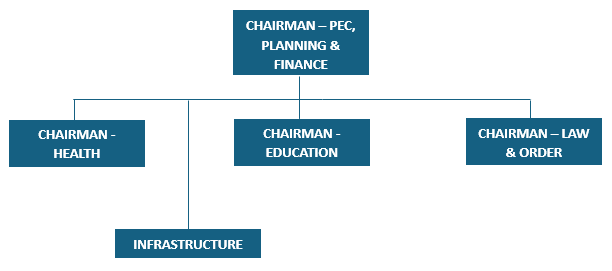
The legislative arm of the WNB Provincial Government is headed and chaired by the Governor, Honourable Sasindran Muthuvel, who also a member of National Parliament. The composition of the WNB Provincial Assembly are the twelve (12) Presidents of twelve (12) respective Local Level Governments, the Members of Parliament representing the three (3) districts namely Nakanai, Talasea and Kandrian/ Gloucester Districts. There also additional four (4) appointed assembly members including Council of Churches Rep, Women’s’ Rep, Business Rep, and Youth Rep.
The Executive Government is the Provincial Executive Council (PEC) which the Governor is the Chairman. The PEC comprises of the five (5) chairmen leading different sectors including Health, Education, Infrastructure, Law & Order, and Planning & Finance. Refer to the diagram below: